 Skip to content

Essential Items for Newborn Sleep Routines: A Practical Checklist
Last Updated: November 6, 2026
Quick Summary
The essential items for newborn sleep routines are a cot or bassinet with a firm, flat mattress, fitted sheets, wearable sleeping bags sized by weight, and a room thermometer to keep the room steady. Everything else is optional, and nothing loose, such as pillows or bumpers, should go in the sleep space.
- Place your baby on their back for every sleep, including naps.
- Press the mattress: it should spring back immediately with no dent.
- Pinch test the sheet: more than a centimetre of loose fabric means the wrong size.
- Check the ACCC for recalls before buying a second-hand cot or bassinet.
- Stop swaddling at the first sign of rolling and switch to a sleeping bag.
Table of Contents
- Why a Short, Prioritised List Beats a Nursery Catalogue
- Safe Sleep Essentials for Newborns: What the Sleep Space Actually Needs
- The Newborn Sleep Checklist: Must-Haves, Nice-to-Haves and What to Skip
- Setting Up the Sleep Space in a Small Room, Shared Room or on the Move
- Frequently Asked Questions
Getting a newborn to sleep well starts with the right gear, but the sleep space is often where new parents get overwhelmed, especially when they are unsure how newborn sleep routines should fit around feeds and nappy changes.
Here is the honest version: a newborn needs a flat, firm surface, a snug fitted sheet, a warm but not overheated room, and a calm routine. Everything else is optional.
Why a Short, Prioritised List Beats a Nursery Catalogue
Long checklists create two problems. They cost more, and they clutter the sleep space, which is the opposite of what a newborn needs.
A common mistake is buying for the nursery you imagined rather than the newborn sleep routines you will actually follow. Babies spend much of their early weeks feeding, changing and being held. Your gear should make those moments easier.
- Start with the sleep essentials that cannot be skipped
- Add comfort items only after you know what your baby needs
- Skip anything that goes against safe sleep guidance
Safe Sleep Essentials for Newborns: What the Sleep Space Actually Needs
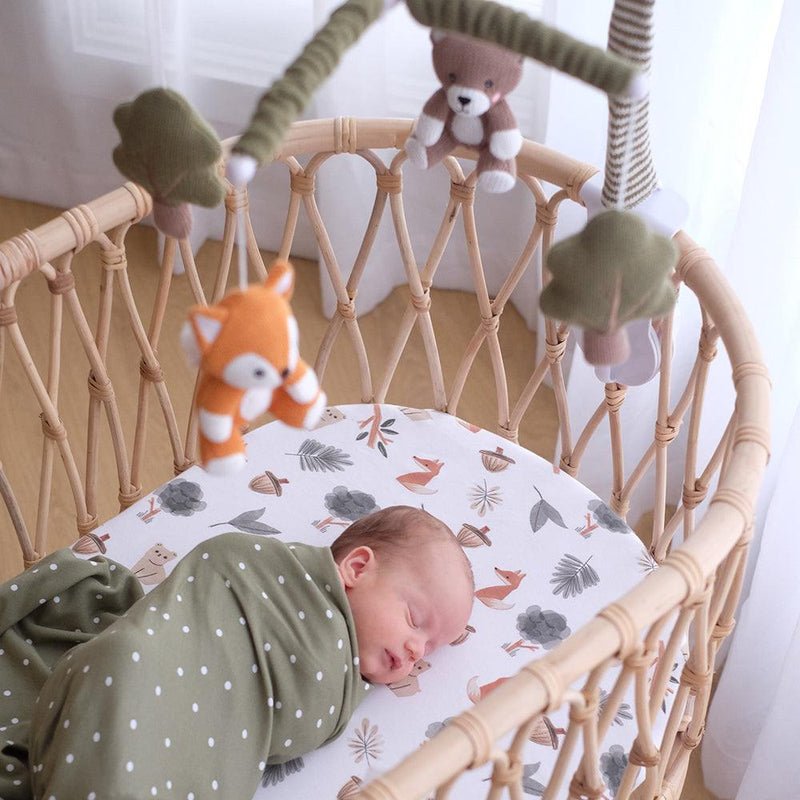
The safest sleep space is deliberately boring. Your baby sleeps on their back, on a firm, flat surface, in a cot, crib or bassinet that meets current Australian safety standards, with nothing else in the sleep space. Each part of that sentence exists for a reason, and understanding the reason makes the setup easier to get right.
Why each rule matters
- Back sleeping. Placing a newborn on their back for every sleep, including naps, is the single most consistent recommendation in safe-sleep guidance. Once your baby can roll both ways on their own, you no longer need to reposition them, but you should still place them down on their back.
- A firm, flat surface. A mattress that does not indent under your baby's head keeps the airway open and prevents the face from sinking into soft filling. Press the mattress with your palm: it should spring back immediately, with no visible dent.
- Nothing loose in the sleep space. Pillows, bumpers, loose blankets, soft toys and sleep positioners can cover the face or trap exhaled air. This is why wearable sleeping bags replace blankets for sleep.
The product checks that make the rules work
Safety guidance is only useful if the gear in front of you actually complies. Before you buy or accept a second-hand item, run through these checks:
- Check the mattress fit. A fitted sheet should hug the mattress with no gaps at the corners and no slack across the middle. If you can pinch more than a centimetre of loose fabric, the sheet is the wrong size.
- Check the cot or bassinet standard. Look for a label confirming the item meets the relevant Australian standard for household cots or folding cots.
- Check for recalls. The Australian Competition and Consumer Commission (ACCC) publishes product safety recalls, including cots and bassinets. Search the model before you buy second-hand. ACCC product safety recalls
- Check for add-ons. Remove any after-market mattress topper, bumper, insert or wedge, even if it came with the cot. These are the items most often linked to unsafe sleep setups.
- Check the sleepwear fit. A wearable sleeping bag should fit snugly at the neck and armholes so it cannot ride up over the face, and it should be sized by your baby's weight, not their age.
Watch out: a mattress that fits one cot will not necessarily fit another, so measure the internal dimensions of your sleep space before ordering replacement sheets or a new mattress.
How to verify the guidance you follow
Safe-sleep advice changes as evidence accumulates, and social media is a poor source for it. Use the current official guidance from your state or territory health department, and check it again whenever you buy new sleep gear or your baby moves to a new sleep space.
Keeping the sleep space simple is not a compromise on comfort. It is the setup that lets you check, at a glance, that everything is as it should be.
Living Textiles - Chenille Blanket - Checkered Pink →
The Newborn Sleep Checklist: Must-Haves, Nice-to-Haves and What to Skip
Use this split to decide what to buy first.
Core items every newborn needs
These are the items most families use every day:
- A cot, crib or bassinet with a firm, flat mattress
- Fitted sheets, two or three sets, so one is always clean
- Wearable sleeping bags sized for your baby's weight and season
A soft chenille blanket is useful for the pram or for snuggles on the sofa. Our Living Textiles Chenille Blanket in Chequered Pink (75 x 100 cm, $42.00) and the Chequered Blue version ($31.99) are made for pram and sofa use.
Helpful extras and what to avoid
Some extras make life easier, but they are not essential:
- Swaddles for the first weeks, if your baby settles better with them
- A change table or a basket to keep nappies within reach
- Baby sleepwear in a couple of tog ratings for different seasons
Avoid anything that adds bulk to the sleep space. Pillows, positioners and bumper pads are best kept out of the sleep space. Browse the wider range of baby products if you want to see what is available before you decide.
Setting Up the Sleep Space in a Small Room, Shared Room or on the Move
Many families sleep their newborn in a small room or the parents' room. A bassinet or portable sleep space works well here.
When travelling, use a portable cot that meets the same safety standards as your home cot. Bring your own fitted sheet, since hotel linen is not always suitable.
(/collections/for-baby) and choose the items that fit your list.
Frequently Asked Questions
What do you need for a newborn's sleep routine?
A newborn's sleep routine needs only a few core items: a firm, flat sleep space such as a bassinet or cot, a fitted sheet sized for that surface, a lightweight wearable sleeping bag or swaddle suited to room temperature, and a way to keep the room dim and calm. Add a blanket for the pram or sofa, but keep it out of the sleep space. Start with these basics and only add extras once you know your baby's pattern, since most of what is sold for sleep is not needed in the first weeks.
What should a newborn sleep in?
Most newborns sleep on their back on a firm, flat mattress in a cot, bassinet or similar sleep space, wearing a wearable sleeping bag or lightweight sleepwear sized for the room temperature. Avoid loose blankets, pillows and soft bumpers in the sleep space. A chenille blanket such as the Living Textiles Chenille Blanket in Chequered Pink, at $42.00, is best used for supervised cuddles, pram rides or tummy time rather than inside the cot.
How do you establish a sleep routine for a newborn?
Keep it simple and repeatable: a feed, a change into sleepwear, a dim room, and a short cuddle or soothing step before the baby goes down in the same place each time. Newborns sleep in short cycles and wake often, so expect the routine to be loose in the first weeks and to firm up gradually. Watch for sleep cues such as yawning or rubbing eyes, and settle the baby before they become overtired.
Two Streets Over works with parents, families and gift-givers who want useful, well-chosen items rather than another stack of generic bundles. Start with the essentials, add extras only when you need them, and keep the sleep space simple. That is the most reliable way to build a settling routine that lasts.
