 Skip to content

Personalised Corporate Gifting Strategies for Financial Advisers
Table of Contents
- Why Generic Gifts Fail Financial Adviser Client Relationships
- Client Appreciation Gift Ideas for Financial Advisers That Actually Get Used
- Building a Corporate Gifting Policy for Financial Services Firms
- Personalised Client Gift Templates You Can Adapt Today
- Timing Your Corporate Gifting Strategies Around Key Client Moments
- How to Scale Personalised Corporate Gifting Strategies Across Your Client Base
- Frequently Asked Questions
Last Updated: September 27, 2026
Why Generic Gifts Fail Financial Adviser Client Relationships
Personalised corporate gifting strategies for financial advisers succeed or fail on a simple test: does the client remember who sent it? A box of snacks duplicated across every name on your book fails that test. It gets opened, half-eaten, and thrown out by Thursday. The client remembers the hamper. They do not remember you.
This guide from Two Streets Over covers what actually works. We build gift boxes for professional services firms, and the pattern is consistent: generic gifting is a wasted spend, not a relationship builder.
Corporate gifting strategies are the deliberate decisions a firm makes about who receives a gift, when, what it contains, and how it carries the firm's brand. Financial advisers face a harder version of this problem than most industries. Your clients are often high-net-worth, time-poor, and already receiving gifts from accountants, lawyers, and lenders. Standing out requires more than a logo on a catalogue box.
Client Appreciation Gift Ideas for Financial Advisers That Actually Get Used
Gifts that get used share three traits: they are practical, they are personal, and they carry your brand without shouting. The ideal client appreciation gift is something the recipient would have bought themselves but did not get around to.
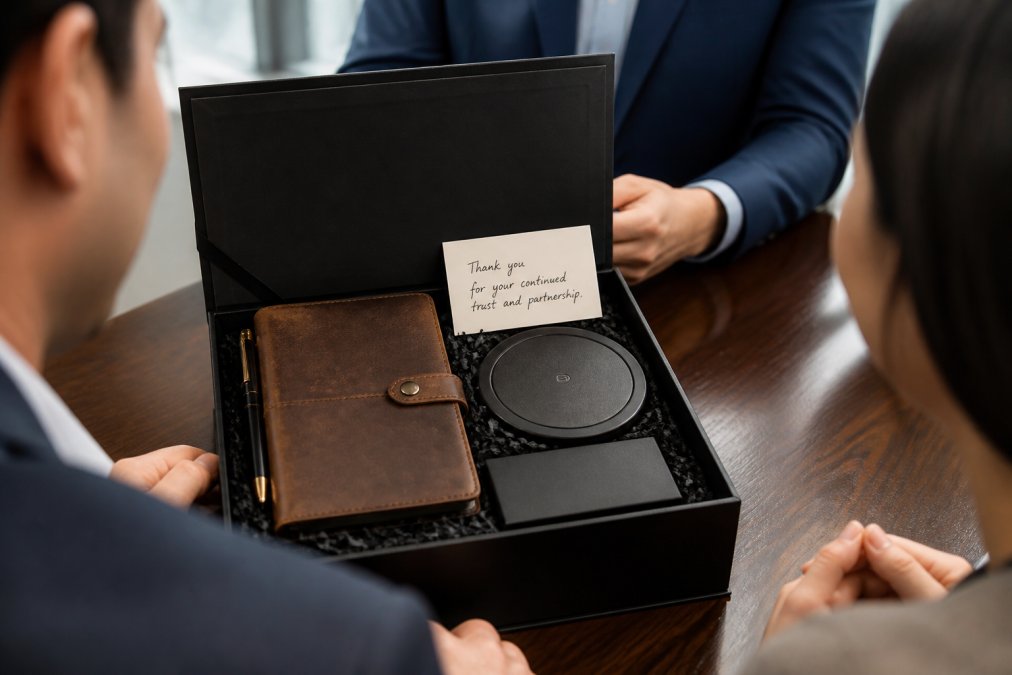
Consider the difference between a decorative item and a practical one. A crystal paperweight sits on a shelf. A quality water bottle, a leather journal, or a wireless charger gets used weekly, and every use is a small reminder of the firm that sent it.
Two Streets Over's Desk Essentials box is a good example of practical gifting done properly: a Caye Life water bottle, a leather notebook, a ballpoint pen, a cable storage bag, and a charger, packed with a handwritten card. Nothing in it is decorative. Everything in it gets used.

Practical Gifts vs Decorative Gifts: What High-Net-Worth Clients Keep
High-net-worth clients are not impressed by volume. They are impressed by fit. A client who golfs will use a quality accessory for years. A client who works from home will use desk items daily. The gift has to match the person, not the budget line.
Gift Type |
Likely Outcome |
Best For |
|---|---|---|
Food hampers |
Shared in the office, forgotten |
No one, in most cases |
Decorative items |
Displayed briefly, then stored |
Rarely worth the spend |
Practical desk items |
Used daily, long-term recall |
Most professional clients |
Used regularly, high perceived value |
Younger and remote clients |
|
Bespoke curated boxes |
Used and remembered |
High-value relationships |
Building a Corporate Gifting Policy for Financial Services Firms
A corporate gifting policy for financial services is a written set of rules covering who receives gifts, what spend is appropriate, when gifts are sent, and how they are branded. It removes guesswork and prevents inconsistent gifting across a firm.

Without a policy, gifting becomes reactive. One adviser sends a generous gift to a top client; another forgets entirely. The client experience becomes uneven, and the firm's brand suffers.
What to Include in Your Policy Document
A workable policy covers six things:
- Eligibility: which client tiers qualify for gifting, and at what relationship stage
- Budget bands: a spend range per tier, agreed in advance
- Occasions: settlement, milestone anniversaries, referrals, EOFY, and festive periods
- Branding rules: how the firm's logo and message appear on the box, ribbon, and card
- Sourcing standards: whether gifts must come from local small businesses or approved suppliers
- Approval process: who signs off on bespoke orders and bulk runs
Personalised Client Gift Templates You Can Adapt Today
Templates save time without sacrificing the personal touch. The card message is where most firms underinvest, and it is the cheapest part of the gift to get right.
Use this structure for a client appreciation card:
Dear [Client Name],
Thank you for trusting us with [specific milestone, e.g. your recent property settlement]. It has been a privilege to work with you over [timeframe].
This box was put together with you in mind. We hope [specific item] earns a place on your desk.
Warm regards, [Adviser Name], [Firm Name]
And this one for an onboarding or new-client gift:
Welcome, [Client Name].
We are glad to have you with us. Consider this a small marker of the start of our work together, and a thank you for choosing [Firm Name].
We look forward to what we build from here.
[Adviser Name]
The rule is simple: name the occasion, name the person, and name one item in the box. Generic gratitude reads as a mail merge.
Timing Your Corporate Gifting Strategies Around Key Client Moments
Timing is where corporate gifting strategies earn their return. A well-chosen gift sent at the wrong moment is forgettable. The same gift sent at the right moment becomes a story the client retells.
Key moments for financial advisers include settlement, a first annual review, a referral from an existing client, a milestone anniversary, end of financial year, and significant life events such as a new business or a retirement.
Send the gift within days of the moment, not weeks. A settlement gift that arrives a month late reads as an afterthought.
How to Scale Personalised Corporate Gifting Strategies Across Your Client Base
Scaling personalisation is the hardest part of corporate gifting for any firm with more than a handful of clients. The solution is not to abandon personalisation. It is to systemise it.
Segment your client base into tiers. Tier one clients receive bespoke gifts built around their known interests. Tier two clients receive curated boxes with a personalised card. Tier three clients receive a standard appreciation gift at key moments. Everyone gets a handwritten message, because that is the part clients actually read.

Two Streets Over supports this at scale through three routes: ready-to-gift curated boxes, a fully bespoke service where the firm briefs budget and occasion and receives something no competitor will send, and a build-your-own option online. For orders of ten or more, bulk pricing applies, and the box, ribbon, and card can all carry the firm's branding rather than the gifting company's.
For firms managing remote teams and clients across multiple states, delivery logistics matter as much as the gift itself. Free delivery applies Australia-wide on orders over $140, with same-day delivery across Sydney metro for orders placed before the daily cut-off.
Financial advisers compete for the same clients, often with the same products and the same fee structures. What separates firms is how clients feel about the relationship between the transactions. A gift that gets used, arrives at the right moment, and carries your brand rather than a supplier's does more for retention than most marketing spend.
Two Streets Over builds premium gift boxes sourced from Australian small businesses, with a bespoke service, ready-to-gift options, and a build-your-own tool, all branded to your firm and delivered with a handwritten card. Get started with Two Streets Over and turn client appreciation into a habit your clients remember.
Frequently Asked Questions
What are the tax implications of corporate gifting for financial advisers?
In Australia, gifts to clients are generally tax-deductible if they are made for business purposes and valued under $300 per recipient (excluding GST). Gifts valued at $300 or more may trigger Fringe Benefits Tax (FBT) unless they qualify as minor benefits. Keep detailed records of each gift, including the recipient, date, and business purpose. Consult your accountant to confirm how your specific gifting strategy fits within ATO guidelines, especially if you send gifts regularly throughout the year.
How do you choose appropriate gifts for high-net-worth clients?
High-net-worth clients often value practicality and quality over extravagance. Choose gifts that reflect their professional lifestyle, such as a premium tech accessory, a leather journal, or a curated box of useful items. Avoid anything too personal or overly expensive, which can feel transactional. The key is thoughtfulness: a handwritten card and a gift that fits how they work or relax will resonate more than a generic hamper. Personalisation shows you pay attention, which builds trust.
When is the best time to send a gift to a financial planning client?
Timing matters as much as the gift itself. Key moments include after a major financial milestone (such as settlement or a portfolio review), at the end of the financial year, during onboarding, or at Christmas. Sending a gift after a significant meeting or when a client refers someone new reinforces the relationship. Avoid sending gifts only when you want something; instead, use them to acknowledge loyalty and celebrate client wins throughout the year.
How can personalised gifting improve client retention rates?
Personalised gifts signal that you see your client as an individual, not just an account number. When a gift is relevant to their interests or profession, it stays in their space and reminds them of your service. This strengthens the emotional connection and makes them less likely to switch advisers. Consistent, thoughtful gifting at key moments builds a pattern of appreciation that clients associate with your brand, which can lead to longer relationships and more referrals.